One of the tests after (significant) changes to an aircraft is a full flight test … before that..you just want to know “Does it still fly straight and level” .. without too much heaving on the stick.
A small test i did on Monday was to get up to around 2,000’… wind on the ground was varying between 11 and 18kts so it would be a bit stronger up there…. and LET GO !
Looking at little like a hijack (but no gun involved 😉) i trimmed, let go of the stick and did a 1 min 14 second turn….hands off .. just judicial use of a bit of rudder to coax her around
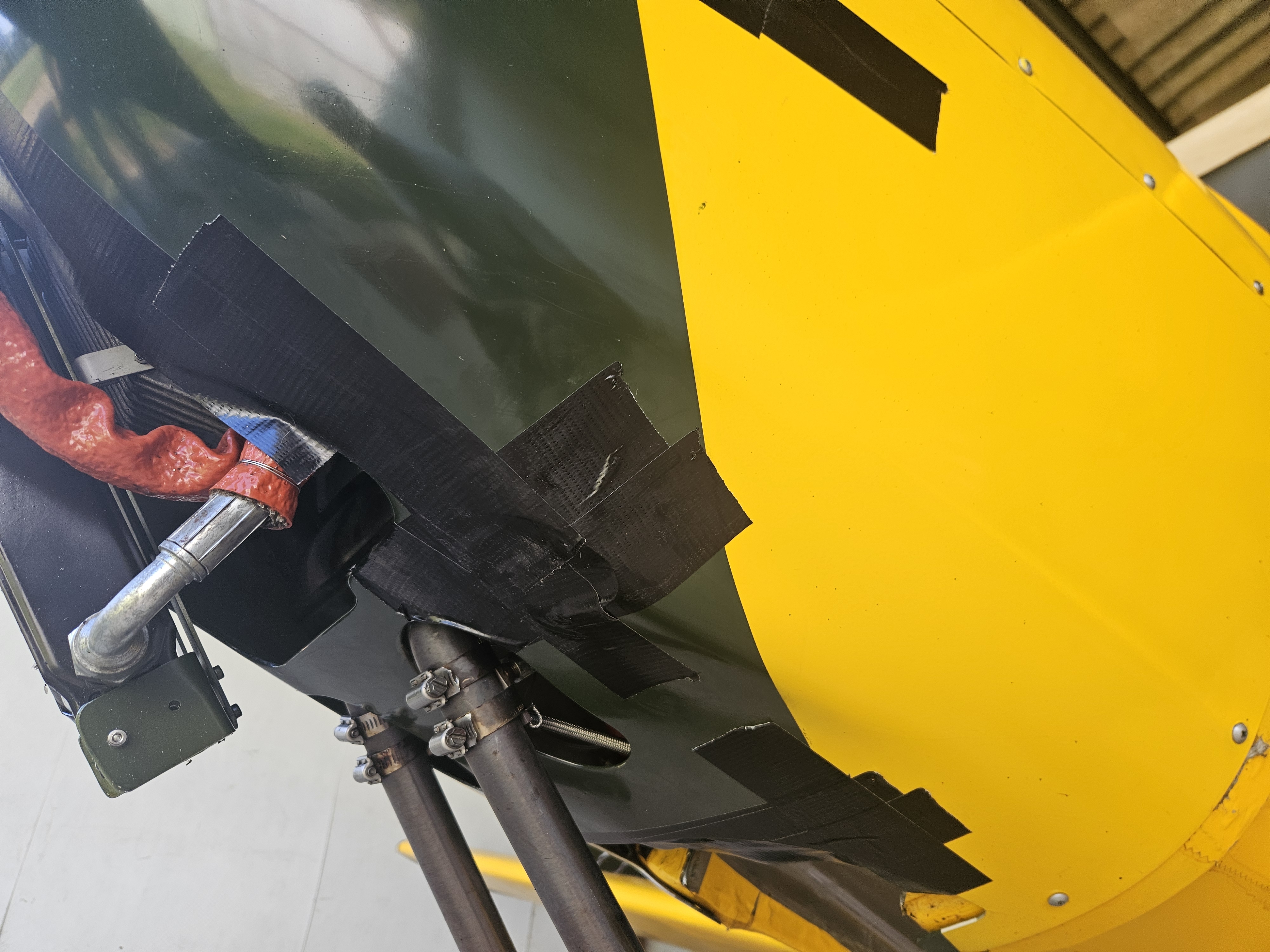
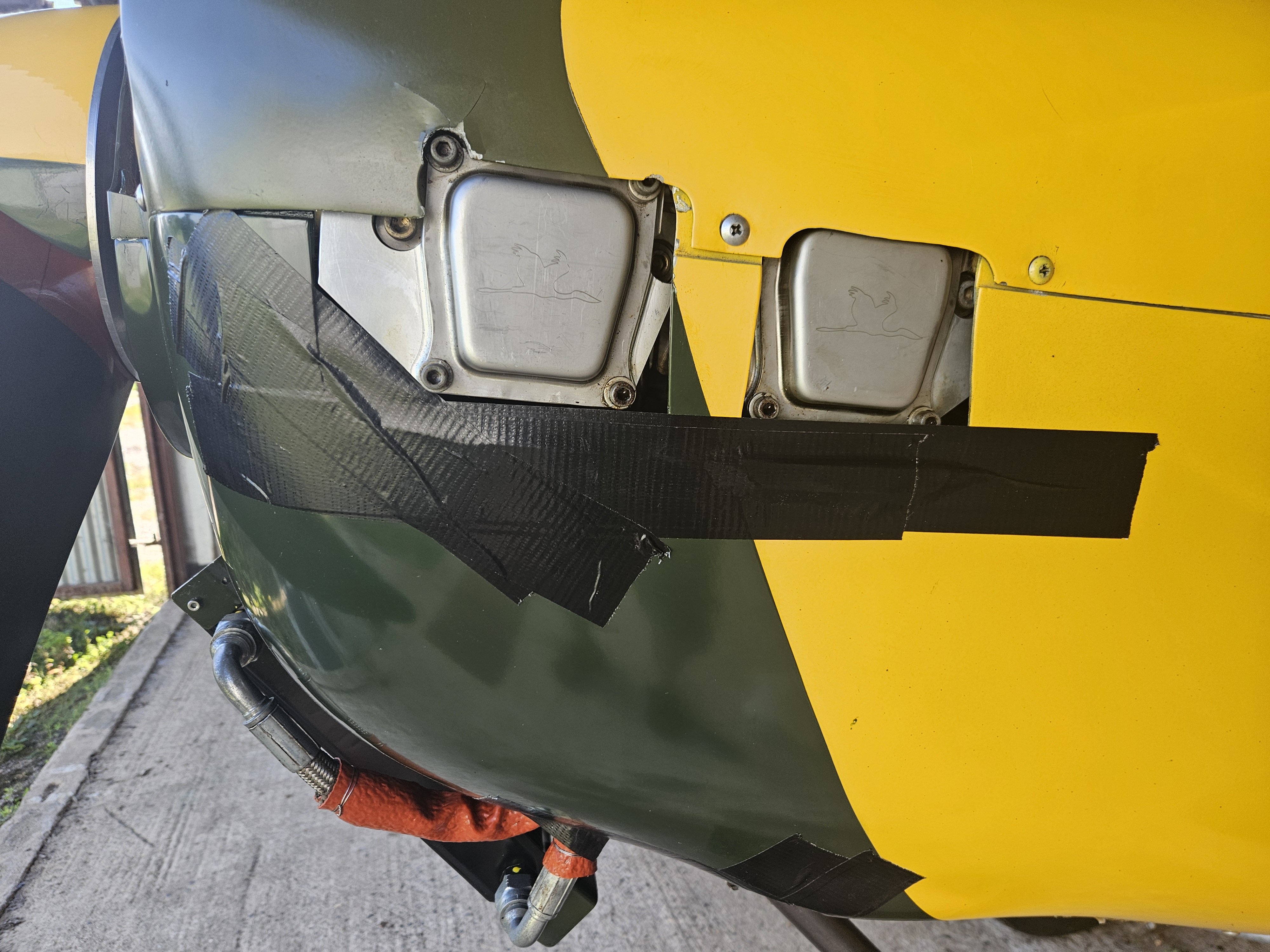
Id been thinking about the hot running head and thought the damage to the lower cowl meant we needed to repair and beef up some of the lower curves.
The original holes in the lower cowl were primarily around exhaust exits, a small hole where the exhaust silencer block touched the cowl, the oil radiator and feed pipes and some cut outs to accommodate the cylinder heads.
The accident crunched the oil radiator into the lower curves of the cowl and that needed beefing up and neatening
The net result was a super strong and great gloss finish but some holes were either enlarged or simply aren’t required anymore.
To test my theory out, without the need to do any ‘hard acts’ on the cowl , I planned to use tape to temporarily block off some of these holes and double the tape so that it would survive a short (30 min) test flight.
A short test flight, which ended up being 41 mins, proved very successful.
Even powered climbs were better than they were before.
Having left it for a few hours and thought about things .. one thing that came to mind on the cooking was the only major thing I changed on the engine following the ‘downing’
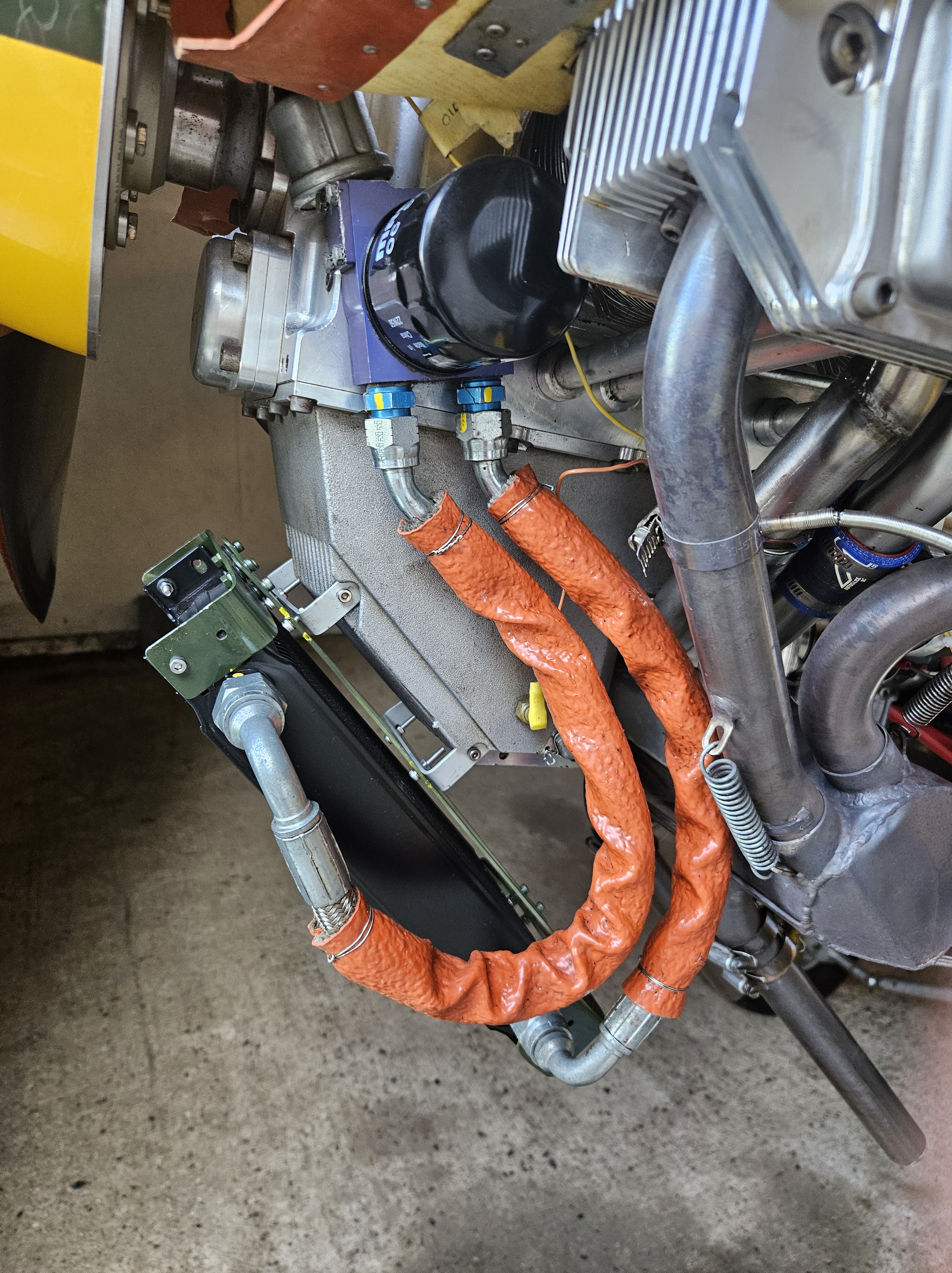
That was a brand new oil cooler matrix ..the original being the only part of the aircraft to take the brunt of the field landing !
This left the old matrix somewhat mashed …i removed it as it was leaking oil in the field on recovery.
What I didn’t do .. was take a photo’ before I removed the old unit and the pipes fitting could easily have interchanged
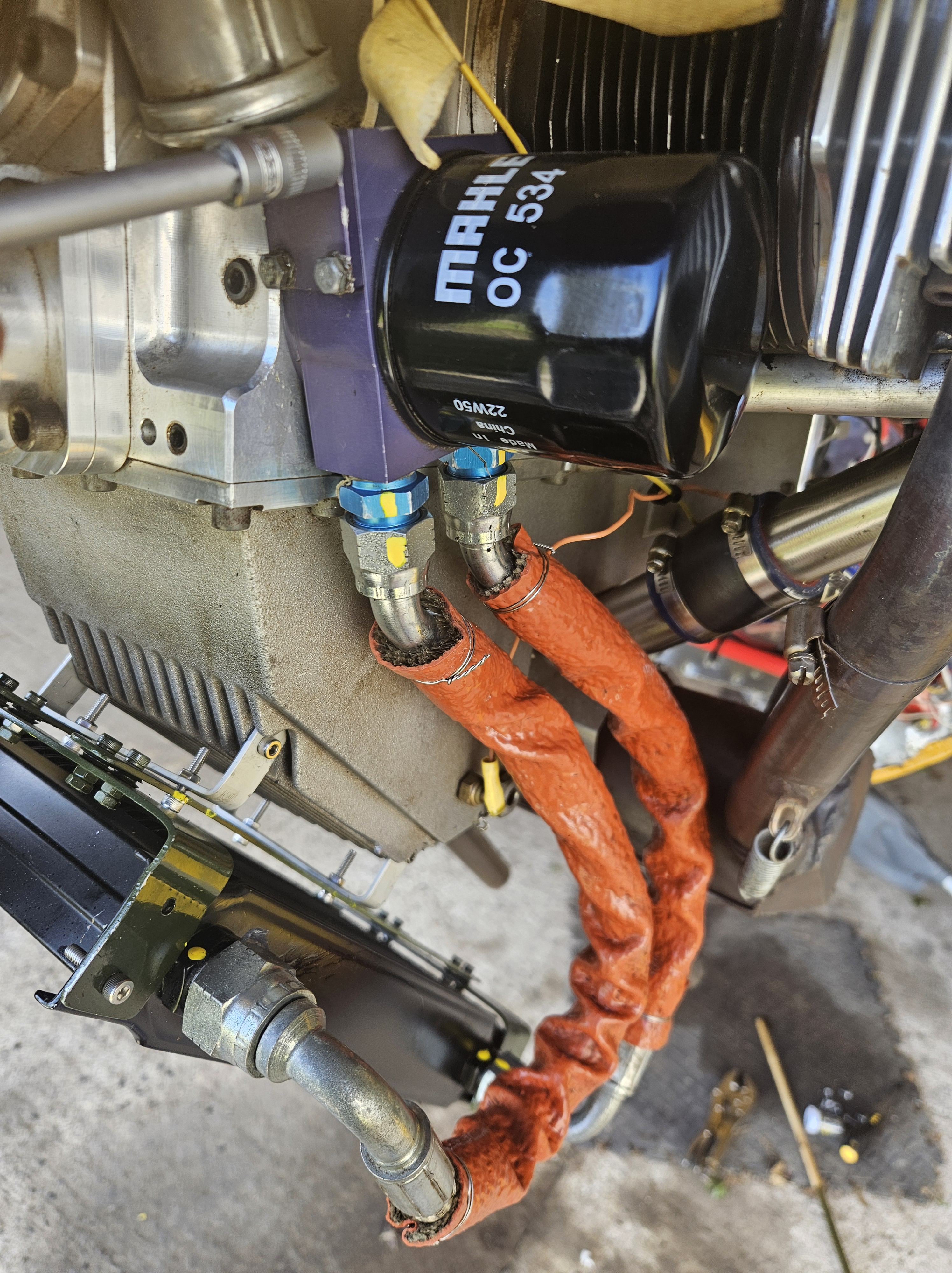
So, Plan A, is to switch the pipes out of the TOCA, the theory being .. if I had the pipes the wrong way the oil would have to be pushed ‘UP’ from the bottom of the oil matrix vs a gravity style ‘in the top’ method of circulation.
Pipes have been switched, so awaiting good wind direction and strength for a retest
Part II – investigation continues …
So, I thought if the TOCA was causing some sort of problem, ie the thermostat was perhaps causing an issue, I would remove it .. like you do with a car .. and the oul just flows .. uninhibited … right?
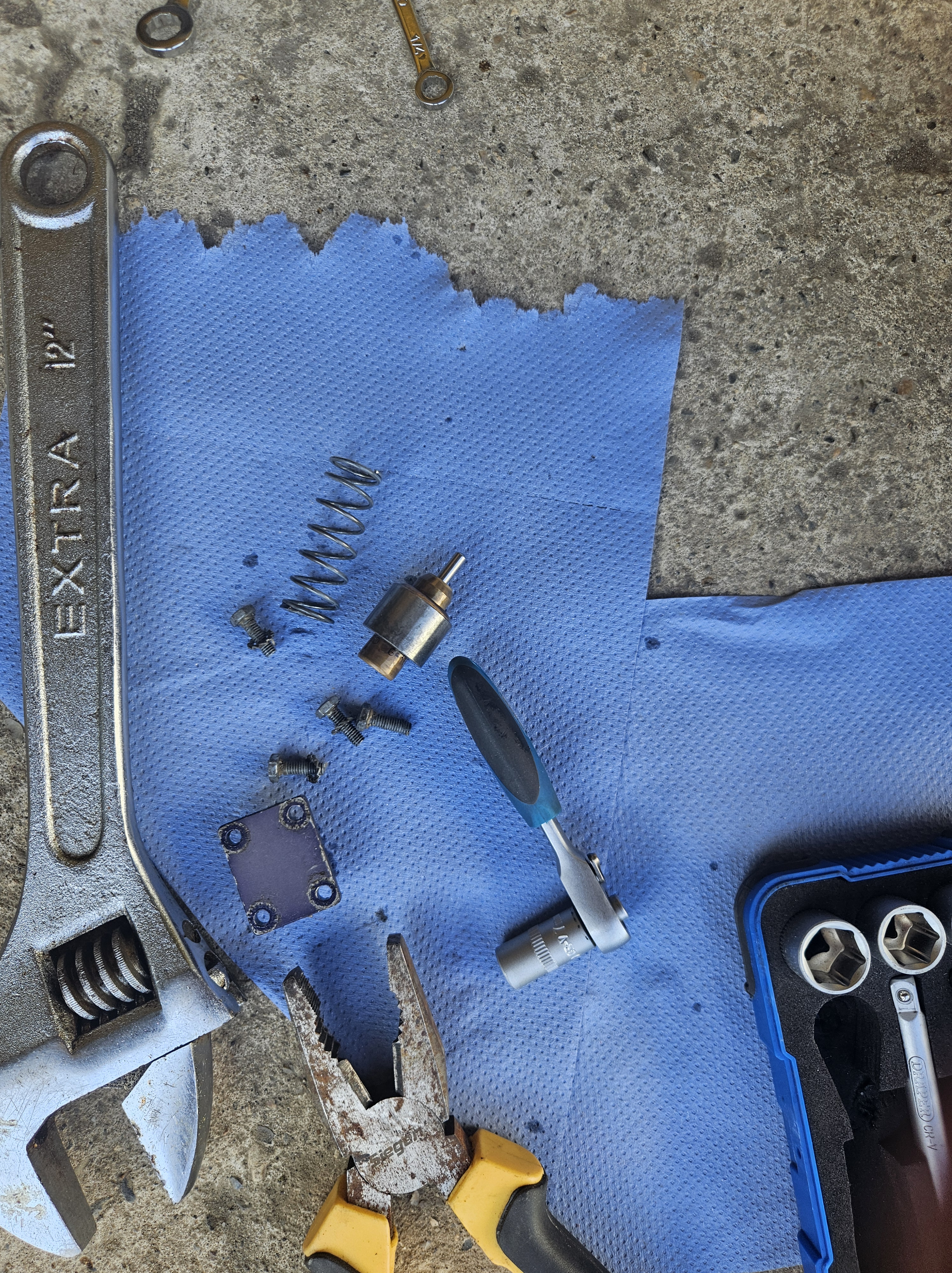
Anyway, removed it, its under a little square plate and easy to remove. Test flight number 4 (without the thermostat in place) and 3 minutes into the flight the oil temp started to climb past 80
Pulling around, throttling right back and brought her in on tickover.
On checking with the Jabiru guru Kevin H… it turns out if you remove the thermostat it CLOSES the feed .. completely!
So although this wasn’t what was required it PROVED what was wrong !
I suspect the thermostat valve is STUCK and needs freeing … then putting it back in for another check
The day finally.arrived, where the paperwork just about exceeded the weight of the aircraft and, all being duly signed, Tom my inspector handed me the clearance paper.
This had already been pre signed by the Head chap at the LAA – major repairs and new builds seem to go through a slightly escalated route to the normal annual update.
The wind on Saturday would have been fine a while back .. 8 or 9 across ..but I didn’t want wind to be a factor at all post the 12 month + rebuild and today, Sunday, it as around 4 across.
Having checked the walk-around for the umpteenth time I had pre fuelled on Saturday, with 20L in the top (holds 36) and 20L in the main (holds 40), i finally pulled her out for start up.
I started up and warmed up and took off with no problems… scooting down the runway to climb out to the North and into the 500′ circuit. The aim was to keep the first few circuits close and ‘glideable’ in case anything was to happen.
A few minutes airborne and a couple of touch and goes, and it was time to come back into the circuit and land. It’s so easy to land this aircraft 😉 so ended up doing a couple.
Leaving it to cool, I removed the top cowling to check all was well in the engine department.
On the 2nd flight I noticed that the oil temp was rising a little on full power as was CHT no 4 …. this was only when pushing the engine a bit (3,200 rpm vs cruise or 2,700) so landed to check.
There was nothing obvious but, I wondered if perhaps the TOCA, the block that prevents cold oil being pushed around the engine (until its up to temp – of 50c, after which the valve opens and lets oil flow through the matrix), had a stuck valve ?
I decided to remind myself of what the TOCA did in terms of functioning, so checked my own blog !
It was simple to remove the thermostat and refit the blanking plate. I can run without this in the summer as the engine quickly gets up to running temp anyway.
The 3rd flight – video below, was a test without the thermostat, and climbed out with a bit more confidence and climbed up to 1,000′ in a slow circling left hand turn.
Passing through about 700 the oil temp started to rise to the high 80s (max is 90 to 100) and the CHT 4 started getting up to 180 vs the 160s of the other 3 Cylinder heads.
I landed back with tickover down to a close right hand base.. keeping the engine cool.. all the way down.
This time on landing i killed the mags quickly on parking and undid straps and jumped out to check the oil feed pipes into the cooler matrix .. both pretty cold !
I parked up and let the whole lot cool down whilst I thought what it might be.


 Jersey Sherwood Ranger